Fletcher Dentistry ALS Ice Bucket Challenge
Thanks to Christene Reynolds at ModestoTaxes.com, Dr. Fletcher accepted the ALS Ice Bucket Challenge! Along the way, he called out four colleagues: Drs. Corey Acree and Kevin Isenhower, Dr. Jeremy West, and his big brother, Dr. Scott Fletcher.
Keep smiling,
Fletch
FED UP CHALLENGE: Dental Care/Health Care
Every morning, our office has what we call a "morning huddle." The entire staff is present and we discuss the day and review every patient that we are scheduled to treat. This simple exercise helps us recognize scheduling conflicts and gives us each the opportunity to collectively prepare for our patients and make certain we are all on board for providing the best care possible.
We use a powerpoint presentation to look through the schedule, discuss our calendar and I also use that time in the morning to educate the entire staff of new procedures and treatment I have completed.
During our FED UP CHALLENGE this past week, I have also used this time to encourage/educate the staff about the effect of sugar on diabetes and obesity. Last week's slides were really good and because we are trying to get this information out to our patients I wanted to share them with you here on the blog. I really hope they help.
It's not too late to join us if you would like! Let us know here in the comments or on Facebook or tweet to us on Twitter that you are FED UP and want to join the challenge!
Keep on smiling,
Dr. Fletch
FED UP CHALLENGE: The Starbucks Addiction
As you may or may not know, from Aug 3 through Aug 10th Fletcher Dentistry is taking part in the FED UP Sugar Challenge. Our goal is three fold: FIRST, we want to kick "added sugar" out of our diets and eat clean for 10 days. SECOND, we want to help our patients by raising their awareness of the sugar epidemic in our country. THIRD, we want to remind each other and our patients to look at what we are putting into our bodies. If we happen to lose weight along the way that will be an added bonus!
I was having a discussion with my kids the other night and the discussion of habits and sugar consumption became a topic of interest. We each commented on the American culture's fascination with sweetened beverages like sodas, energy drinks and flavored coffee drinks. The conversation became a bit more specific as we each knew people with a Starbucks addiction! Spend any amount of time on social media and you will see how deeply Starbucks has worked itself into the fabric of our culture. (Like the townspeople in Shrek 2, when their "Farbucks" is destroyed they run across the street to another "Farbucks").
This discussion caused me to start thinking. How does a sugar addiction relate to Starbucks? Consider again that the daily recommended levels of sugar (grams/day) consumption are as follows:
- Men: 36 g of sugar/day
- Women: 24 g of sugar/day
- Teen/PreTeen: 20g of sugar/day
I put together a quick graphic to show you a few of the popular hot and cold drinks from Starbucks. How does your favorite drink compare to the recommendations above:
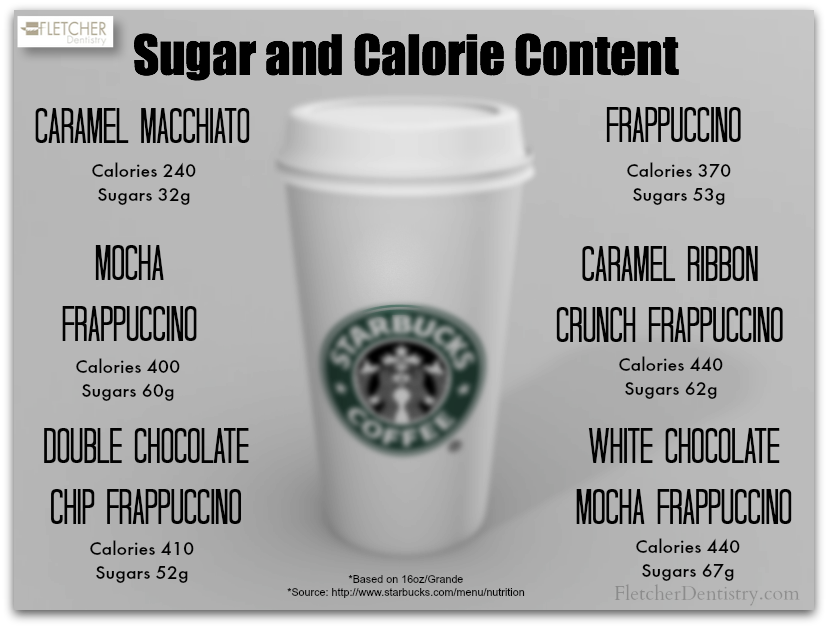
Click on the picture to go to the Starbucks Nutritional Guide information provided online.
If you look at the chart one thing should stand out. Based on sugar recommendations by the American Heart Association, each of these drinks are out of range for the typical person.
The natural response would be to mimic your favorite drink with sugar-free versions of these drinks right? The problem with that thinking is that the sugar is missing, but the effects on your body from sugar substitutes are still there.
“Artificial sweeteners slow your metabolism, make it difficult for your blood sugar to regulate and make you crave and eat more food.”
Artificial sweeteners slow your metabolism, make it difficult for your blood sugar to regulate and make you crave and eat more food. So people who are trying to lose weight by choosing sugar-free products are actually making it more difficult on themselves. The solution is simple: cut the sugar and sugar-free alternatives. Eat and drink clean.
Convinced? Remember, our goal is awareness! Hope we helped this morning!
Keep smiling,
Dr. Fletcher
Fletcher Dentistry is FED UP
At Fletcher Dentistry we are FED UP with the negative effect of sugar on our health. For years you have heard our office talk about sugar as it relates to tooth decay, but now we are talking about the role sugar plays on our total health!
Our good friend, Dr. John Beech, from Beech Chiropractic and Functional Medicine in Turlock, CA has challenged us to the 10-Day FedUp Challenge. The goal is to GO SUGAR FREE FOR 10 DAYS, by cutting sodas and other sweetened beverages and foods that have ADDED sugars. We are choosing to EAT real, fresh, whole foods and stop consuming all products that contain ADDED sugar. This includes all artificial sugars and sugar substitutes.
Consider These Statistics
When Dr. Fletcher started dental school, only 12% of Americans were statistically overweight. Today, nearly 35% of American adults and almost 1 in 5 children are obese - not just overweight, but clinically and diagnostically obese. How many people is that? The total estimate is near 93 Million Americans that are obese!
In 1980, there were ZERO reported cases of childhood Type II diabetes. In 2010, that number swelled to over 57,000 cases of Type II diabetes in kids ages 8-19. That is absolutely ridiculous!
Why Is This All About Sugar?
Sugar has the same addictive properties as tobacco and alcohol and the more sugar you eat, the more you need to satisfy your craving. Sugar can be found in an alarming amount of foods, and half of it is hidden by calling it one of its 56 other sneaky names, it can be hard to determine exactly how much sugar is in any particular product.
Are You Saying That All Sugar Is Bad?
Natural sugars that you find in fruit are fine. (Not fruit juice though!). We are concerned about the ADDED sugars. We are also concerned with the artificial sweeteners because they increase hunger. Our goal during this challenge is to stay away from ADDED sugars and all artificial sweetners.
How Much Is Bad?
The American Heart Association has put together the following recommendations. Check out the number of recommended teaspoons each day:

What Does That Really Look Like?
A 20oz bottle of soda contains almost 15 teaspoons of sugar!
1 teaspoon of sugar equals 4 grams of sugar.
It will take a 110-pound child 75 minutes of bike riding to burn off the calories in that 20oz bottle of soda.
HERE'S WHERE IT GETS REALLY GOOD
We want you to join us! We don't just care about your dental health, but we care about your TOTAL HEALTH. So join us and let's get serious about what we choose to put into our body. Here are the steps you can take!
1. Sign up at the FED UP CHALLENGE website and register!
2. Watch the three videos below:
3. Let us know you are FED UP too! Leave a comment here on this blogpost, send us a Facebook message or Tweet to us that you are #FEDUP and check out our Facebook/Twitter feed daily for encouragement! Each of us will share tips for avoiding sugar, eating healthy and conquering the addiction to ADDED sugar!
Keep on smiling,
Dr. Fletcher
Children's Dental Health Month
This month, Dr. Fletcher visited Hariette Kirschen Elementatry School in Modesto, CA for Children's Dental Health Month. This was Dr. Fletcher's 15th year at Kirschen school presenting his own personal dental health program for the students(complete with toothy dinosaurs, giant underwear and a ring of toothbrushes). He also screened a few dozen children for tooth decay and dental needs.
Yesterday, Fox News published an article by Julie Relevant from HealthyMama.com about calming your child's dental fears. You can read it by clicking on this link or by clicking on the picture.

Afraid of the dentist? 9 tips to calm your child’s dental fears
By Julie Revelant - Healthy Mama Published February 23, 2014 FoxNews.com
The advice given in this article is very good and I would only add one small suggestion. I've always thought it was a good idea for parents to bring their child along for one of their dental visits. When your kids see you getting your teeth cleaned, examined or repaired, they are given a first hand look at how easy it is to visit the dentist.
For questions about your children's dental health or suggestions about taking better care of their teeth, contact our office.
Keep on smiling,
Dr. Fletcher